Too Bad I Don’t Care SVG
A Designer’s First Look: Sassy, Clean, and Surprisingly Versatile
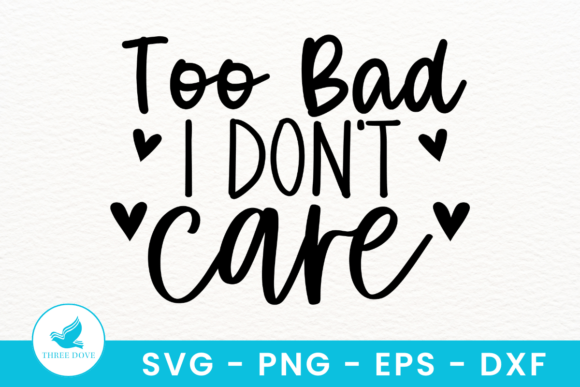
When I opened the Too Bad I Don’t Care SVG file for the first time—yes, before even loading it into my embroidery software—I paused. It’s not flashy, but it’s loaded with personality: bold, slightly slanted sans-serif lettering, tight kerning, no extra flourishes, no nurse cap or stethoscope clichés (despite the “Nurse SVG” label in the description). It reads like a quiet eye-roll turned into wearable wit—perfect for a boutique tote bag, a minimalist sweatshirt, or even a cheeky kitchen towel for the overworked healthcare worker who *actually* needs to laugh.
How It Translates Off-Screen and Onto Fabric
This isn’t just a T-Shirt Designs graphic—it’s a machine embroidery design waiting to be tested. In real-world use, Too Bad I Don’t Care SVG shines on medium-weight fabrics where stitch clarity matters: cotton twill aprons, brushed poly-cotton sweatshirts, and structured canvas totes. I stitched it on a 100% cotton tea towel last week—used tear-away stabilizer, 40-weight rayon thread, and a 5×7 hoop—and the result held up beautifully after two washes. The letterforms stayed crisp; no bleeding, no puckering. That’s because the design avoids fine serifs, micro-details, or overlapping strokes—smart choices for an embroidery file meant for real production, not just screen display.
Where It Fits—and Where It Needs Caution
Too Bad I Don’t Care SVG works best when treated like a confident, no-nonsense statement—not a delicate accent. It’s ideal for:
- Custom apparel like unisex crewnecks and oversized tees
- Embroidered patches (heat-seal or sew-on) for nursing students or clinic staff
- Baby embroidery on soft cotton onesies—just size it down to 3.5" wide and use lightweight cut-away stabilizer
- Holiday embroidery on linen pillow covers for the “I survived another year” crowd
- Small shop product tags or branded packaging for craft businesses that lean into dry humor
But proceed carefully on:
- Stretchy fabric (like jersey knits)—letter spacing can distort without proper stabilizing and reduced stitch density
- Curved surfaces like caps—test alignment first; the straight baseline doesn’t auto-adapt to crown curvature
- Dark fabric with light thread—preview your digital embroidery file in black-and-white mockups to confirm legibility
- Tiny hoop sizes (<4")—the original layout assumes ~4.5–5.5" width; scaling below 3" risks losing punch in satin-stitched edges
What It Does for Your Craft Business—Beyond the Stitch
As an Etsy seller and small shop owner, I don’t just ask *“Will this stitch cleanly?”* I ask *“Will this make someone click ‘Add to Cart’ twice?”* Too Bad I Don’t Care SVG delivers subtle commercial intelligence: it’s niche enough to stand out in saturated markets (nursing gifts, medical humor), yet broad enough to appeal beyond clinical settings—think teachers, therapists, admins, or anyone reclaiming their energy. Customers recognize authenticity. When they see this on a handmade product, they trust the maker understands tone, timing, and audience. That builds repeat buyers—not just one-off holiday embroidery sales.
Design Assets That Earn Their Keep
The included PNG (300 DPI, transparent background) is more than a bonus—it’s your shortcut to professional listings. Use it for printable mockups on neutral sweatshirts or tote bags, then pair it with a short, human caption like *“For the nurse who’s done explaining her boundaries.”* That kind of specificity converts better than generic “cute nurse design” copy. And because the SVG is compatible with Cricut Explore and Silhouette Designer Edition, you can easily adapt it for hybrid projects—say, heat-transfer vinyl + embroidery combo on a denim jacket.
Practical Embroidery Designer Notes You’ll Actually Use
Before stitching your first finished product, do these five things:
- Test on scrap fabric—especially if using textured fabric like terry cloth or looped fleece
- Check thread color contrast against your base fabric under natural light (not just screen preview)
- Review stitch density in your embroidery software—if fill areas look overly dense, reduce density by 5–8% for breathable wearables
- Confirm hoop size compatibility—this design fits comfortably in a 5×7, but verify your machine’s max dimensions before hooping
- Inspect small details—the “I” and “l” are distinct, but at tiny scales, they risk blending; zoom in and adjust if needed
Also: double-check licensing before listing on Etsy or selling embroidered patches commercially. The listing says “DIGITAL DOWNLOAD ONLY”—so confirm whether personal use, small business resale, or digital product redistribution is permitted. When in doubt, contact the creator directly. Clarity here protects your craft business and reputation.
Final Thought: It’s Not Just a Graphic—It’s a Vibe You Can Stitch
Too Bad I Don’t Care SVG succeeds because it respects both the maker and the wearer. It doesn’t overpromise. It doesn’t clutter your workflow with unnecessary layers or incompatible formats. It’s a clean, confident, ready-to-embroider graphics asset that works across sweatshirt embroidery, baby embroidery, and even holiday embroidery—without needing reworking. For creative entrepreneurs who value efficiency *and* emotional resonance, this isn’t filler. It’s functional wit, stitched right.