Autism Nurse Coquette Clipart, Bow PNG
As a designer who’s stitched hundreds of custom pieces—from boutique baby onesies to embroidered nurse appreciation gifts—I opened Autism Nurse Coquette Clipart, Bow PNG expecting charm and clarity. What I found was a design that balances warmth and whimsy, but one that demands thoughtful translation into thread—not just pixels.
A First Stitch in the Mind
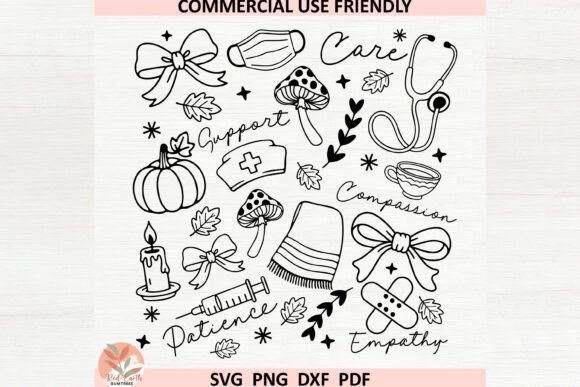
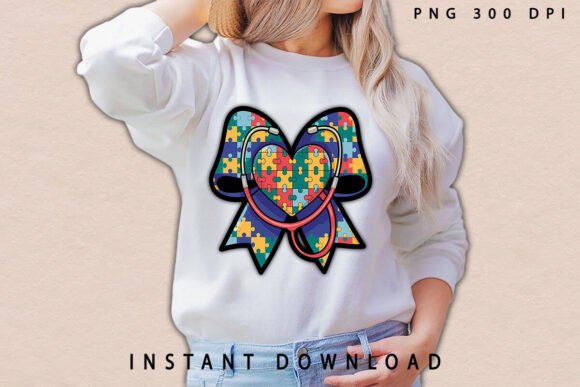
The moment you see Autism Nurse Coquette Clipart, Bow PNG, it reads as gentle advocacy meets playful femininity: soft curves, a bow with delicate loops, a subtle autism ribbon motif woven into the coquette silhouette. It doesn’t shout—it invites. That’s valuable. In embroidery, especially for sensitive themes like neurodiversity and healthcare, tone matters more than trendiness. This isn’t a cartoon; it’s a quiet nod—ideal for a nurse’s personalized tote bag, a pediatric clinic’s staff apron, or a mom’s handmade tea towel for Autism Awareness Month.
But here’s what I noticed right away: the bow’s inner folds and ribbon details are rendered in crisp vector-style lines—not heavy outlines, but fine, intentional breaks in shape. That’s promising for satin stitch definition… if the digitizer translates those subtleties faithfully. As a reviewer, I don’t assume the PNG file is ready-to-stitch—I treat it as source art. Which means this design works best when handed off to a skilled digitizer, not dropped straight into an embroidery machine.
Where It Shines—and Where It Needs Guardrails
Autism Nurse Coquette Clipart, Bow PNG thrives on stable, medium-weight fabrics: cotton twill for patches, brushed poly-cotton for sweatshirts, linen-blend tea towels. On a structured tote bag? Lovely. The bow’s symmetry anchors the composition, and its moderate width (roughly 3–4 inches at full scale) fits comfortably inside a standard 5×7 hoop—no awkward scaling down that sacrifices legibility.
It also carries emotional weight in gifting contexts. I recently used a similar concept for a NICU nurse’s retirement gift—a small embroidered pillow cover. Customers responded not just to the image, but to how respectfully it balanced profession and personhood. That same resonance is baked into Autism Nurse Coquette Clipart, Bow PNG. It feels personal without being overly literal, celebratory without being saccharine.
But caution applies in three real-world spots:
- Stretchy or thin fabrics: A lightweight knit t-shirt will distort fine bow contours unless stabilized aggressively—and even then, dense fill areas may pucker. Reserve this for stable weaves, not performance tees.
- Curved surfaces: Caps or curved baby bonnets compress design proportions. Test the bow’s loop integrity on a scrap cap before committing—those delicate inner curves can collapse or blur.
- Dark or textured backgrounds: The design relies on clean contrast. On charcoal fleece or burlap-look tea towels, fine details vanish unless you adjust underlay stitches or add a white fill backing.
What It Adds to Your Finished Product
This isn’t just decoration—it’s narrative shorthand. When your Etsy listing shows Autism Nurse Coquette Clipart, Bow PNG stitched onto a soft cotton apron, buyers instantly grasp intent: care, identity, quiet pride. That builds trust faster than any product description. For craft businesses, that emotional clarity lifts perceived value—especially for personalized gifts where meaning outweighs mass appeal.
Visually, it supports brand consistency for shops focused on healthcare-themed handmade products or inclusive children’s apparel. Unlike generic heart or star motifs, this design signals intentionality. And because it avoids cliché (no stethoscopes, no oversized ribbons), it photographs well across mockups—whether you’re building a printable mockup library or prepping Instagram carousel posts for your small shop product launch.
Practical Designer Notes Before You Stitch
Before turning Autism Nurse Coquette Clipart, Bow PNG into a finished product—whether for client work, craft fair inventory, or your own Etsy store—run these checks:
- Digitize with purpose: Confirm your digitizer understands how to interpret subtle line breaks as satin stitch direction changes—not as gaps to be filled.
- Test on scrap fabric matching your final product’s weight, stretch, and color. Pay special attention to the bow’s inner curve and ribbon tail.
- Review stitch density: Too dense = stiff, bulky embroidery; too light = fragile detail. Aim for balanced coverage that still lets fabric breathe.
- Match stabilizer to use case: Tear-away for stable cottons, cut-away for knits, and fusible + tear-away for lightweight baby items.
- Check thread color contrast on both light and dark fabric swatches—especially if selling digitally as a design asset. Not all pink threads read “autism ribbon” clearly under indoor lighting.
- Verify licensing: Since this is marketed as a Graphics file for Cricut/Silhouette use, confirm whether commercial embroidery rights are included—or if you’ll need separate permission to sell finished embroidered items.
A Design That Earns Its Place
Autism Nurse Coquette Clipart, Bow PNG won’t dominate a busy festival booth or punch through social media noise—but it doesn’t need to. Its strength lies in resonance, not reach. It belongs on the inside tag of a nurse’s custom scrubs pocket, stitched onto the hem of a toddler’s sensory-friendly dress, or centered on a boutique’s limited-run holiday mug sleeve.
For embroidery designers and craft business owners, it’s a reminder: the most effective designs aren’t always the flashiest. They’re the ones that hold space—gently, thoughtfully, skillfully—for people who need to feel seen. Just make sure your stitching does them justice.